
Connecting Logical Thinking, 3D Printing and Environmental Sustainability
The 3D Academy and Green Detectives projects aim to demonstrate how technology, creativity and education can contribute to environmental protection and sustainable development.
One of today’s major environmental challenges is the increasing amount of electronic waste generated when devices and everyday objects are discarded instead of repaired. In many cases, a product becomes unusable because a small plastic component has broken, even though the rest of the device remains functional.
To address this problem, students need more than technological tools. They need to develop logical thinking, spatial reasoning, creativity and problem-solving skills.
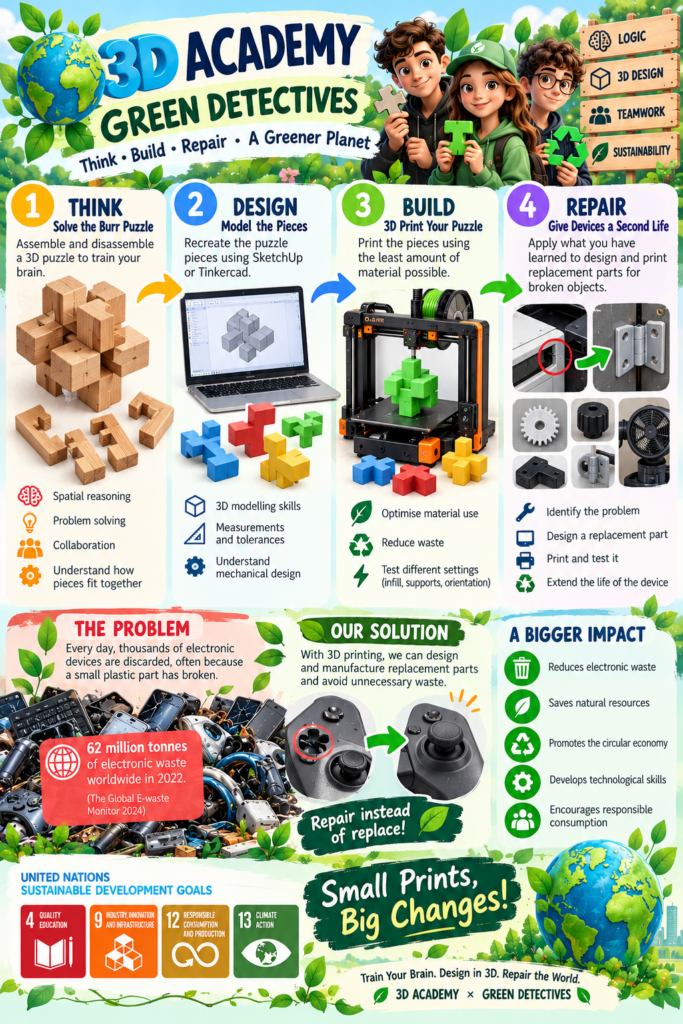
The Burr Puzzle provides an engaging starting point for developing these abilities.
A Burr Puzzle is a three-dimensional mechanical puzzle consisting of interlocking pieces that must be assembled and disassembled through a precise sequence of movements.
By solving these puzzles, students practise spatial reasoning, logical thinking, patience, planning and collaborative problem-solving. They also discover how different components interact to create a complete structure.
These concepts are closely connected to engineering, 3D modelling, mechanical design and the repair of everyday objects.
The activity follows a progressive learning process:
Think: Students solve a Burr Puzzle, exploring how its components fit together and identifying the movements required for assembly and disassembly.
Design: Students use 3D modelling software, such as SketchUp or Tinkercad, to reproduce the puzzle pieces and understand their dimensions, geometry and mechanical relationships.
Build: Students manufacture their own puzzles using 3D printing, learning to optimise material consumption, reduce printing waste and create functional components.
Repair: Finally, students transfer their knowledge to real-world situations by designing and printing replacement parts for broken objects and electronic devices.
Through this approach, students discover that the same skills used to solve a three-dimensional puzzle can help them understand how everyday products are assembled, how their components interact and how damaged parts can be replaced.
The activity also promotes the principles of the circular economy, encouraging students to extend product lifespans, reduce unnecessary consumption and minimise waste.
By combining game-based learning, 3D design, digital manufacturing and environmental education, the project transforms a traditional mechanical puzzle into a meaningful STEM learning experience.
It also supports the United Nations Sustainable Development Goals, particularly SDG 4 (Quality Education), SDG 9 (Industry, Innovation and Infrastructure) and SDG 12 (Responsible Consumption and Production).
From Solving Puzzles to Solving Environmental Problems
Our goal is to inspire students to become creative problem-solvers who understand that technology is not only about manufacturing new products, but also about repairing, reusing and preserving the resources we already have.
«Train Your Brain. Design in 3D. Repair the World.»
3D Academy × Green Detectives
Small Prints, Big Changes!